Wet, Wintry Conditions Are No Match for BMW xDrive
Story by Dwain Hebda // Images Provided
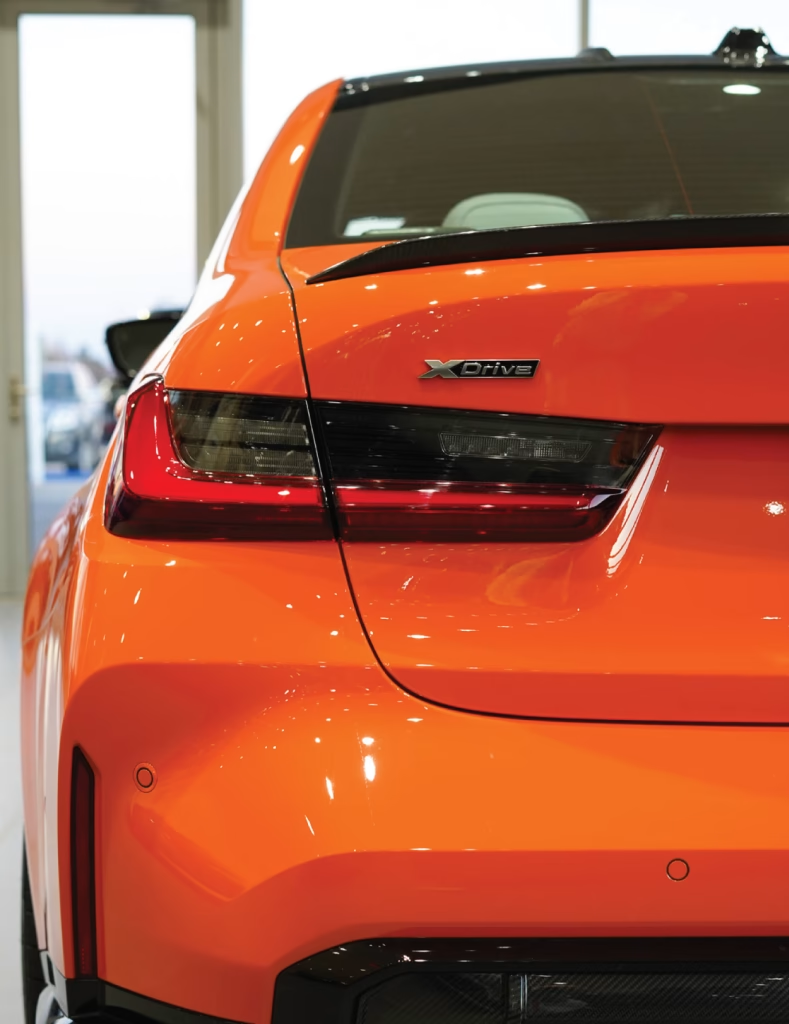
Of all the luxurious and beautiful features that set BMW apart from the herd, it is the smallest of details that truly earns the automaker its title of “The Ultimate Driving Machine.”
Take, for instance, the revolutionary xDrive system. Chances are that the driver will never even see or notice it, even as the technologically advanced system provides smooth, secure driving in all weather conditions.
“I personally think it’s the best system out there as far as all-wheel drive controls are concerned,” said Nick Appletoft, mini service manager with ONYX Automotive. “I drive a four-wheel drive truck, and if you were put my truck up against a vehicle with good tires and xDrive, the xDrive’s going to outperform it. There really is no comparison.”
Appletoft isn’t alone in his assessment. Numerous driving magazines and automobile websites have all declared the xDrive all-wheel drive system to be a revolutionary landmark in automobile engineering. The always-on system optimizes traction and works to keep a vehicle in its lane when it detects a potential road hazard from water, snow, and ice. Combining multiple sensors and an on-board computer, the system kicks in when needed, and does it so quickly that it is virtually invisible to the driver.
“The xDrive system is constantly monitoring for wheel slip due to either power input, like a vehicle doing a burnout, or if a wheel is slipping due to adverse weather conditions,” Appletoft said. “If it senses a slip, it will individually brake wheels and cut throttle response. It’s looking for vehicle stability, not just traction, so it’s there to correct, say, if the vehicle goes into a slide.”
Even given Nebraska’s notoriously fickle weather—from blazing summer heat, to gully washing springtime rains, to frigid winters—the xDrive is just what the doctor ordered. In fact, as J.D. Power noted, the xDrive system is actually geared toward customers who live in colder climates.
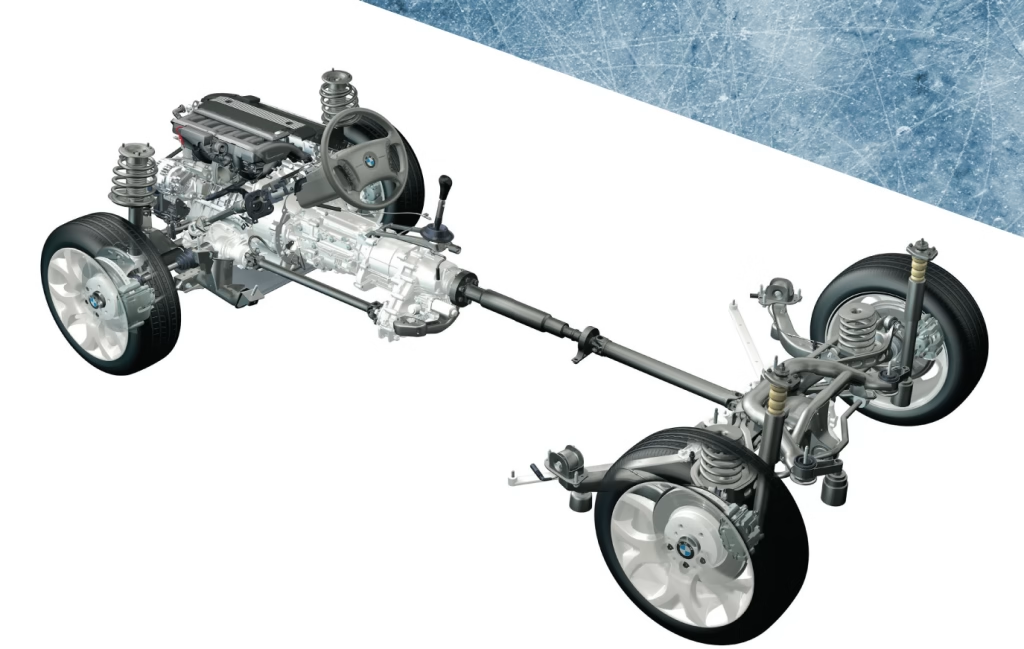
Using a network of sensors feeding data continuously to a central computer, xDrive monitors each wheel to incredible accuracy, detecting slippage or skidding due to wintry or rainy conditions. Under normal circumstances, the system distributes power between the rear and front axles at a ratio of 55% to 45%, respectively. When traction loss is detected, the system automatically corrects a skid by sending more power or applying brakes to maintain stability.
Per BMW USA, the xDrive system can change the power distribution ratios dramatically and instantly, and is smart enough to send all power to the wheel or wheels with the most traction, even if that’s just one wheel out of four. Braking is equally precise, applied in milliseconds to appropriately correct the vehicle based on conditions.
“The biggest advancements in the system were introduced in the mid- to late-2000s,” Appletoft said. “First, they went from a traction control-only system with ABS, which wasn’t capable of braking individual wheels, to where it is now. Obviously, there’ve been a lot of improvements along the way, but the big advancement was being able to individually brake wheels based on slippage and vehicle stability.”
Were that the extent of it, the system would already be one of the most technologically advanced all-wheel drive systems on the market, but xDrive takes things a step further. Besides wheel speed and traction, the system constantly measures a myriad of other factors, including the angle of the steering wheel, brake force, and pressure on the gas pedal, and uses that data to allow the vehicle to react in the optimum manner.
“It takes into account a lot of different sensors; sensors on the vehicle, the steering angle sensor,” Appletoft said. “There’s a yaw sensor that’s right in the center of the vehicle that would detect if the vehicle goes into a slide, as well as all four wheel speed sensors, one at each wheel.”
Of particular interest to Nebraska motorists, xDrive also assists drivers stuck in snowy conditions, per BMW USA. Dynamic traction control provides the necessary wheel spin and brake adjustments to keep the vehicle moving forward without losing power when things are slippery underfoot, except in the most extreme driving conditions, all while maintaining complete control.
Perhaps most ingenious of all, the system is even intelligent enough to distribute torque appropriately in driving situations without wheelspin, such as in cornering. If the system detects the car starting to oversteer or understeer, it reacts by giving more or less grip to the appropriate tires to correct it.
All of this happens so smoothly, most drivers are none the wiser when the system kicks in, be it for weather or cornering.
“Especially if there’s just a little bit of wheel slippage, the driver’s really not going to know anything, they’re just going to think they’re an awesome driver,” Appletoft said with a laugh. “When you have a snowy day like we get in Nebraska and the vehicle’s really digging in, the driver might see a traction control light turn on the dash. That indicates the vehicle’s hitting that second level of operation.”
Appletoft said the system requires only general maintenance to keep it running optimally, including sticking to the recommended schedule of brake fluid flushes every two years, or as recommended by a routine diagnostic check. The transfer case, which controls the transfer of power as needed, should also be serviced every 60,000 miles or so to ensure peak performance.
Appletoft also noted that while the system can technically be disabled, xDrive remains in background mode in case the driver’s taste for road adventure outstrips their ability to handle it safely.
“It will allow you to turn the system off, but it’s never really off,” he said. “It’ll still intervene; for instance, if the vehicle were to go into an uncontrolled slide, it will still activate. It’s always going to be on to some degree.”
For more information, visit bmwusa.com.