For 75 years, Bridges Trust weathers storms, leverages opportunity
Story by Dwain Hebda // Photography by Bill Sitzmann
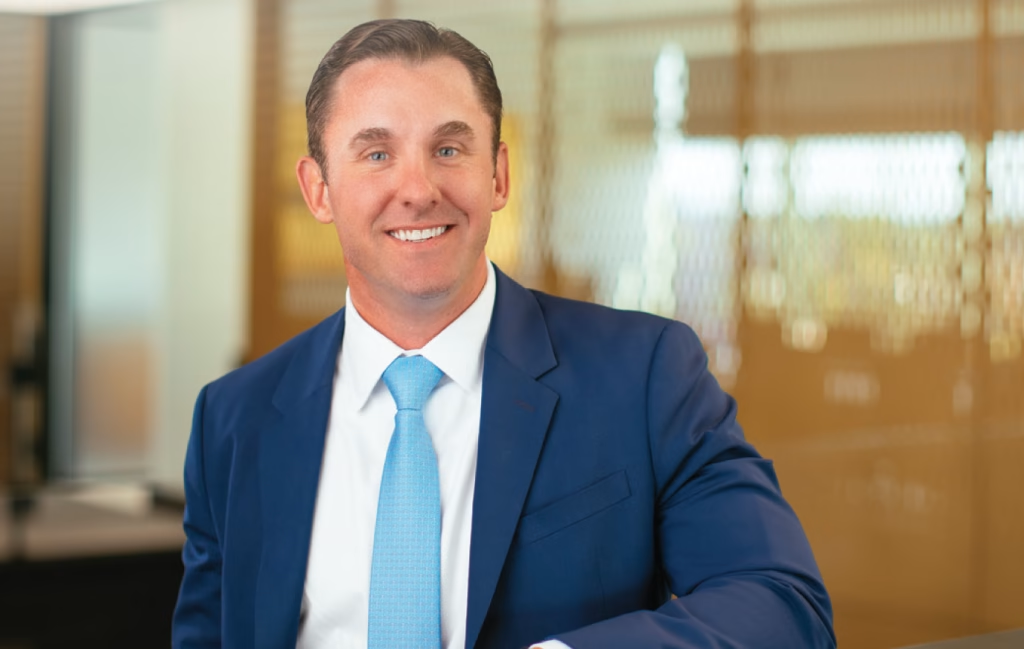
As a third generation CEO of the family firm, Ted Bridges embodies the unbroken code of ethics upon which Bridges Trust was established by his grandfather, Marvin Bridges Sr., and carried on by his father, Edson II.
But where many see Omaha’s size and location as liabilities, Bridges underscores them as the major underpinnings of the company’s 75 years in business and as catalysts for the firm’s accelerated growth as of late.
But as the chief executive whose tenure sits at the crossroads of significant capital markets growth and unprecedented challenges caused by 2020’s COVID outbreak, Bridges’ impact on the wealth management company is uniquely his own.
“When I joined BT in spring of 1983, I was probably the ninth or tenth employee of the Firm at that time. We had about $150 – 200 million of assets under management,” he said. “By 2017, we had 22 employees, just short of $2 billion in assets under management and approximately 300 client relationships.”
“In the past five years, we’ve grown to over $8 billion of assets under management, 65 employees, and over 700 client relationships located in approximately 40 different states.”
Bridges pauses, as if letting those numbers sink in for the very first time, seeking the words to sum up the success of three lifetimes in his family.
“We’ve grown significantly over the years,” he said at last. “We have had incredible support and patience from our clients. I think the Midwest is known for a hard-working ethos. Bridges Trust displays such character and we’re people who are willing to roll up our sleeves and do well by the people who have trusted us with their money.”
Seeing how substantially Bridges Trust has grown, one almost forgets how remarkable it is that the firm is here at all. Independent family operations are increasingly scarce in today’s financial services landscape, especially those like Bridges Trust which are smaller and operate outside the country’s major metropolitan areas and their attendant enclaves of the super-wealthy.
“About half of our clients live within a couple hours’ drive of Omaha. Our practice is regional if not national as we have clients in 40 states,” he said. “But importantly, many of the clients that we serve are multi-generational in nature. We have a number of families we work with where we’re on generation three or generation four. I’m very proud of that.”
“Operationally, if someone says, ‘You’re not that big,’ our response would be ‘we’re not as big as some of the very largest [firms], but our size allows us to provide a level of service that is high-end and high-touch relative to larger firms. There’s a boutique aspect to our DNA, to our culture, and to our capabilities. Our mindset allows us to be nimble and flexible enough to build client-specific investment solutions at scale, things some larger firms just can’t do.”
This build-to-suit mindset has not only proven very effective with their legacy clients; it’s also a particularly appealing selling point for the newest generation of investors, a segment accustomed to retail and service marketplaces that cater to their individual needs and lifestyle.
“We are not a one-size fits-all. We don’t have models that we box our clients into,” said Nick Wilwerding, the firm’s President and COO. “We listen to what their objectives are, both on the investment and/or wealth side for their families and institutions, and then we design the strategies that meet those objectives.”
Wilwerding said Bridges Trust has proven itself adept in blending its heritage skillset and financial acumen with modern technology to provide enhanced customer-facing tools. This aspect of operations, which provided a useful work around during pandemic restrictions, is now a key selling point to the rapidly growing number of clients who prefer to conduct traditionally face-to-face transactions online.
“We have seen a continued push from clients across our practice, regardless of size and complexity, that are demanding premier digital access, quick and efficient turnaround on requests, and more and more 24/7 accessibility to our relationship managers,” Wilwerding said. “I would say that has always been the case for some of our larger, more institutional relationships, but now we’re seeing it across all 700 of our relationships, regardless of size.”
“We’re delivering a robust digital experience and will continue to do so. Fundamentally, clients want to know their money is being well-managed, they want to understand what we’re doing and why. We’re looking to invest in better and better technology to facilitate and communicate that.”
More than mere bytes and bots, the company’s evolution in meeting the needs of its newest generation of investors is also rooted in an understanding of the changing dynamics of investors, even within longtime client families.
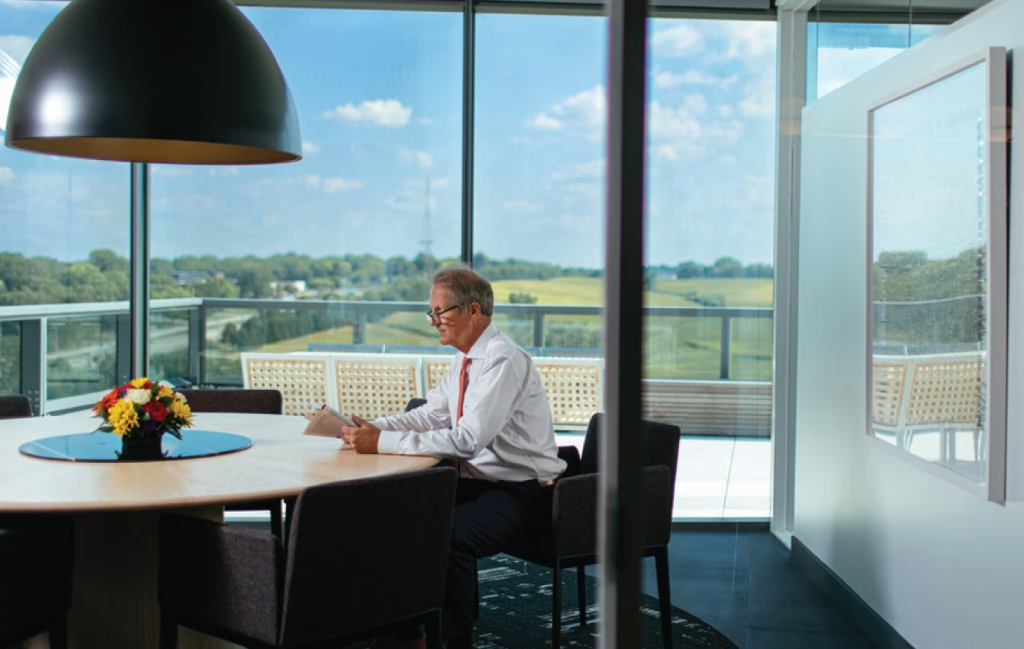
Bridges said the firm has done a good job of connecting the dots between the perspective of the patriarch that made the family fortune and the succeeding progeny who inherit the proceeds.
“We have made significant investments in resources in order to effectively serve families over a series of two, three, and four generations. The breadth and depth of resources that we have to serve a family over multiple generations is where our Firm excels,” Bridges said.
“The Firm’s overall investment philosophy and process is our North Star and is applicable across generations, thereby helping clients achieve their long term objectives,” he continued.
“However, as we work across generations, investment objectives do change, and the culture of the family also changes. There will be more family members in gen three than there were in gen one for example, with many of those family members coming in through marriage,” Bridges explained.
“Thus, the family’s values can change over time. Bridges Trust becomes the institutional memory for the family and we’re a resource to help educate and communicate within and across family generations over time.”
“For instance, it’s likely gen one eventually gets to a point where conservation of wealth is the primary objective, whereas in gen two, generating cash flow to support lifestyle might be more important, and gen three might be, ‘We’re younger, we want to grow the capital, and we have more appetite for risk,'” Bridges said. “We work with families to achieve that balance, applying a broad investment philosophy and process with the needs of each generation in mind.”
As for the next generation of the Firm itself, Bridges said while there’s not a fourth generation of his family immediately involved in the business, the Firm has been successful in hiring and developing significant depth and breath of talent such that the company’s next 75 years will continue to enjoy success rooted in its foundational principles.
“The only way you can do that is to be highly intentional about the people you add to the organization, making sure that those who you bring on embody the cultural elements that are the most important to the organization as it serves a larger growing client base,” he said. “Our role, ultimately, is to serve clients by understanding what their needs are and then building investment solutions with the goal of delivering results as efficiently as possible.”
“You can find people that have a heart for service, and you can find people that have a lot of professional investment management skills. Finding people who have both is more difficult, but we have built a team that has strengths in service and skill which defines our long lasting culture.”